The joy of pork
The whole hog
Oct 30th 2008
From The Economist
JOHN BARLOW, a British expatriate in Galicia, the rain-swept region of the Spanish north-west that gave birth to Franco, has an odd ambition: to eat every bit of a pig, from its tail to its snout. The ambition persists despite marriage to the long-suffering Susana, perhaps the only Galician vegetarian, despite the menace of cholesterol from all those fat-laden pork sausages and despite the threat (kindly pointed out by Susana) that eating pig brain will lead to Creutzfeldt-Jakob disease.
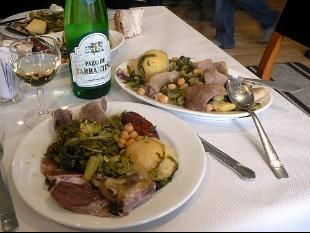
What follows is a quixotic quest for the recipes that give good countryfolk—and doubtless Mr Barlow—ample waistlines and cheerful characters. The cocido (pork stew) from the politically conservative town of Lalín is nothing short of heroic in its mix of ingredients; there are kind words for Doña Aurora’s trotter stew; and an enthusiasm for blood sausages whatever the gruesome process of making them.
All this may be great fun for foodies, but the attraction of Mr Barlow’s book is that he goes well beyond the business of eating. He gives us a fascinating journal of his Galician wanderings, from village carnivals in the pouring rain to a hippy commune in the back of beyond via the pilgrimage to Santiago de Compostela. What comes through is a deep affection not just for Galicia’s pigs—Mr Barlow singles out the long-backed Galician Celtic, hips swaying like Jayne Mansfield’s, for special mention—but also for Galicia’s people and culture.
No answer is ever a straightforward yes or no. No bureaucratic process is ever simple. No bit of history is without its compelling trivia (how many others would know, for example, that in Santiago de Compostela’s 12th-century church of Santa María Salomé there is a statue of an angel wearing glasses?). Mr Barlow pokes his nose in everywhere, and almost without exception people are kind and hospitable.
He meets all sorts, from Fidel Castro’s favourite cousin to Mañuel Fraga, minister under Franco, co-author of Spain’s democratic constitution and still Galicia’s political godfather. The charm is that Mr Barlow is so self-deprecating: his interview with Don Mañuel is a classic encounter between clueless journalist and superior, but patient, politician; his account of teaching phonetics at La Coruña’s university will make many a teacher blush with self-recognition; his Yorkshireman’s contempt for the posh British expatriate with barely a word of Spanish will amuse anyone with a knowledge of Britain’s class system.
None of this yet puts Mr Barlow in the Eric Newby category of travel writer, but he comes close enough in this, his third book. As for Susana and baby Nico, they are sometimes there, and sometimes not. But Susana, it seems, never complains, even though Mr Barlow’s ambition is clearly to indoctrinate Nico into the pleasures of pork.
If you want to know more about this book:http://www.johnbarlow.net/jb_books.asp?bid=26&p=notes#http://www.flickr.com/photos/22612314@N07/